

The First Secret
Part 1The Box
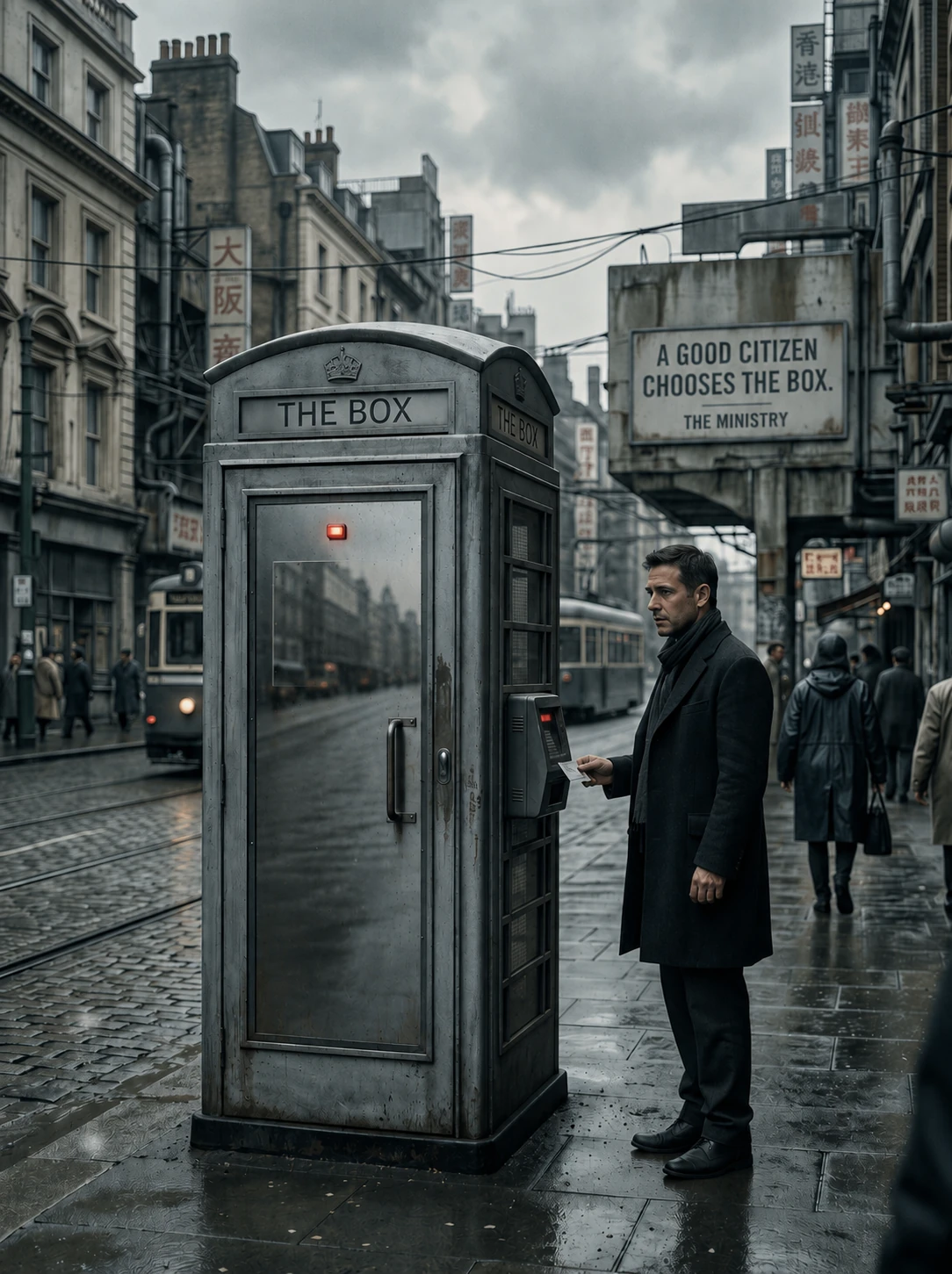
One
I never paid much attention to the Boxes. Gray steel, standing squarely along the sidewalks on every block, with a red light over the door and a payment scanner on the side panel. Yet they looked like something the city had always had, the way you stop noticing a scar. They were both prominent and invisible.
I liked systems because they had a beginning you could point to. The tram network had a founding order in the public archive. The ration system had a first issuance, dated and signed. The system of Boxes was less easy to understand. Once, years ago, half-joking, I'd gone looking in the public records for the founding order on the Boxes. I didn't find one. I mentally filed it under, “the archive loses things sometimes,” and moved on.
Today I stopped in front of one anyway. My own face looked back at me in the steel. The door was shut, the light dark. No plaque, no date, nothing to tell you which decade it was built in. The Box just had a door that led to a process that led to an end, that, as far as I could tell, wasn’t for the general population to be concerned about.
Some time ago, Harold Harrow used this one. I remember his wife at her window that evening, not moving, forehead against the glass. By the next morning, she was back on her balcony watering the same three pots she always watered. Thirty-seven years, folded up and put away as if nothing had happened.
I'd told myself it wasn't my business. That the system worked, that whatever he'd said in there had gone somewhere and done something. Standing here now, I couldn't remember believing that, only deciding to.
"Jonas."
I turned to see Mrs. Harrow in her housecoat, a string bag of bread in one hand. We looked at the Box together like it was a third person in the conversation.
"He waited a while," she said. "Before he went in."
I nodded. I didn't ask what he'd waited for.
"Did he tell you what he was going to say?"
She was quiet long enough that I thought she wasn't going to answer. "Does it matter?"
I didn't have anything for that.
"You'll be late," she said, gentler now. She turned to go. I almost let her.
"Mrs. Harrow." She stopped, waiting.
"I know," she said, before I got any further than her name. "I know where you work now. The whole building knows, Jonas." Something moved behind her eyes, not surprise exactly. "Just remember, they were people first," she said. "Before they were paperwork." She didn't wait to see if I understood. I watched her go, then checked my watch and ran for the tram.
The tram car was packed, all wet wool and hot circuitry. A loop ad flickered over the door: A "GOOD SECRET KEEPS THE STATE STRONG." The face on it froze mid-smile and reset. Nobody looked up.
I got off the tram at the Ministry. It was bigger than I remembered. The entrance ate people one at a time through a blue scanning field, patient and thorough. A sign directed new hires to follow a blue line down a corridor to a large room with rows of wooden desks. Inside, a man in a pressed gray uniform handed me a binder without introducing himself. NISO Z39.301-2087: END-OF-LIFE PROCESSING PROTOCOLS. He walked me past rows of terminals where nobody looked up and told me, "The system runs itself." And then he led me to an empty desk. "Ellick," he said, as if he were reciting a password rather than an introduction.
He left before I could ask anything. I sat down and opened the binder to a flagged page holding what was labeled as an inconsistency: Section 6.3.1 used the word "statement," 6.4.2 used "declaration." My job was to pick one, cite precedent, and submit for approval.
I flipped to the copyright page out of habit, looking for the first edition. NISO Z39.301-0001. It wasn't there. The trail just started at the current revision and looked backward at nothing.
An intercom voice sent new hires to Room 17-B. I closed the binder and went.